Final third of Advent of Code ‘25 in Java

Let's go through the final third of this year’s Advent of Code.
Day 9: Movie Theater
Covering the floor with red tiles… and maybe also some green in case it would be too simple.
First part was pretty easy, very simple thing to literally brute-force. On the other hand… the second part was a bit worse.
My idea was a pretty primitive one, just do the same thing as in the first part and filter out the options that are not valid.
Turns out that the process of deciding what is and what is not valid is the problem.
In the end I have managed to refactor the solution into:
@Override
Long part1() {
  return getBiggestTriangle(_r -> true);
}

@Override
Long part2() {
  return getBiggestTriangle(this::isValidRectangle);
}
Changes to library
“Queue consumer”
This was the second day when I had to utilize the heap consumer1, so I have
decided to factor it out to the library. Since the method itself accepts
an object implementing Queue<T> interface, I have renamed it
to consumeQueue():
/**
 * Creates a stream that consumes elements from a queue.
 *
 * @param <T> the type of elements in the queue
 * @param queue the queue to consume elements from
 * @return a stream of elements from the queue, in the order they are polled,
 *     terminating when the queue becomes empty (when {@code poll()} returns
 *     {@code null})
 */
public static <T> Stream<T> consumeQueue(Queue<T> queue) {
  return Stream
    .iterate(queue.poll(), _it -> queue.poll())
    .takeWhile(it -> it != null);
}
pairs() and helpers
For iterating over the possible choices, in this puzzle, I had to generate all possible pairs from an input. Overall it made sense to just implement a method that takes a stream and generates the pairs:
public static <T> Stream<Pair<T, T>> pairs(Supplier<Stream<T>> xs) {
  return zip(indices().boxed(), xs.get())
      .flatMap(p ->
        xs.get()
          .skip(p.first() + 1)
          .map(y -> Pair.of(p.second(), y)));
}
However, in the end, I needed some other helpers to get there… Namely it was
easier to implement infinite indices() rather then iterate the stream twice.
Also you can notice that pairs() gets passed a Supplier<Stream<T>> rather
than the stream itself. That's coming from the fact that streams can be iterated
through only once, so I need to have a functional object that generates a new
stream each time I need it.
Day 10: Factory
Pressing buttons to light up christmas lights in specific configuration. Until you realize it's not about the on and off, but about the “joltage”…
This day… was a scam. For the first part you had to light up lights on the machine in a specific configuration. Part of the input were buttons that contain a list of lights that get toggled with each press.
A lot of people chose to go with integral representation of the lights and buttons and then just applying simple XOR.
I didn't try to simplify the inputs, so I've ended up with lists (or sets) of integers and used BFS for solving the first part.
And… second part is where the fun starts.
Input consisted of multitude of machines where each one is represented by:
- indicator lights - used in part 1
- buttons - that toggle indicator lights
- joltage - used in part 2
For the part 2 you have to find minimal number of presses to raise joltage to the seeked joltage…
The search space for this problem is enormous… I've tried a very naïve approach of preprocessing the buttons for each machine in such order that narrows the search space. This approach was relatively effective, but not effective enough 😄 To cut the story short, I've ended up with 97 % of the input processed, but got stuck there for 3.5 hours after which I killed it.
Once the solution has been running for about 30 minutes, I have started to pick away here and there to optimize bit by bit. And it was pretty effective! To sum it up:
-
I had a method to generate counters (i.e.,
long[]of zeros); in the initial solution I usedrange().map().toArray(), switched it to simplenew long[] -
for read-only operations, where possible, I've switched to parallel streams instead of sequential
-
changed the strategy of exploring the search space; instead of going from minimum needed to maximum possible presses of a button, I've turned it around and went from maximum possible to minimum needed, which prunes the unreachable branches quicker
-
and finally the recursive calls that get called for each button press… for each of this calls I create a separate “goal” joltage the search is supposed to address, that way I can paralelize those too
And this has gotten me from 3.5 hours (still missing the last 4 results) to 6 minutes.
Day 11: Reactor
Counting possible paths through a network of devices.
Relatively easy way to solve this. Can be done recursively, it's basically just going through the graph, trying to find a way to the goal. And at the same time counting how many ways there are…
I have to admit that I did not expect to get burnt at this Java-specific thing on the 11th day 😄 I've been teaching at Intro to programming for years that sometimes it's not a good idea to use niche features specific only to one or two languages, yet… At first I didn't realize at all that
if (from == sink) {
  return 1l;
}
does something totally different than
if (from.equals(sink)) {
  return 1l;
}
== compares references, and, as opposed to other languages like C++ or C#,
cannot be overriden. However I noticed this mistake rather quickly, cause the
graph traversal doesn't terminate, duh…
I expected to make this mistake during the beginning, not at the second to last day.
Day 12: Christmas Tree Farm
Puzzle about tiling problem. However the challenge input is a bit more simpler than the complicated sample…
At the first look, the problem looks extremely annoying. And it kinda is… The fun thing is that it is possible to solve simply by expecting a bit more area, as a buffer, to be occupied by the tiles and simply checking whether it could fit.
What's even more funny is the fact that the provided sample is quite picky about this, i.e., you need to account for 20 % buffer to make it pass. However the challenge input… that works without any buffer…
Final changes to the library
Parser.of()
I've tried to simplify the parser a bit, so I introduced a method Parser.of()
to be able to construct instances of parsers without the need to use new and
<> for type inference of the resulting types to be produced by parsing…
Summary
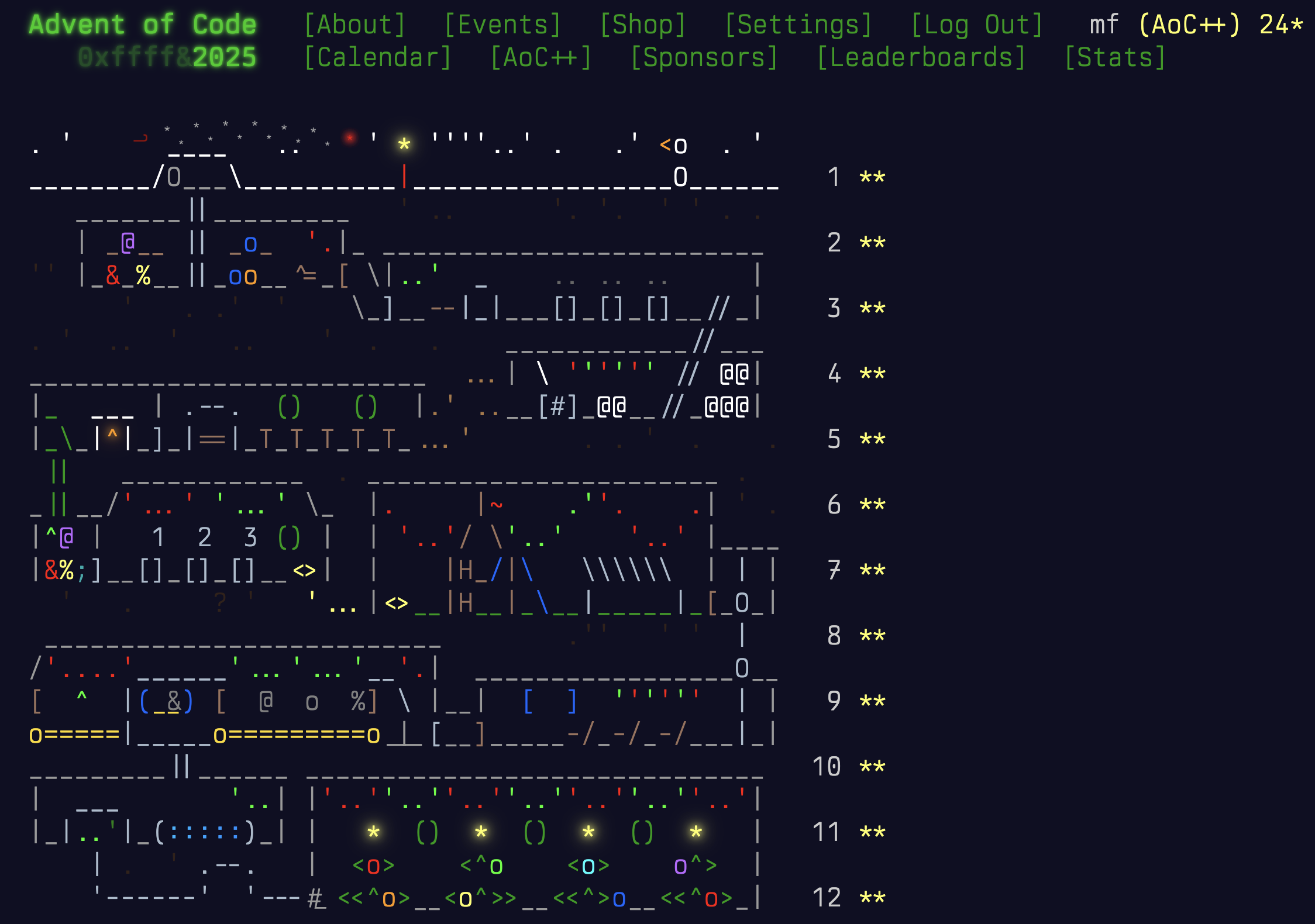
Advent of Code itself
I have a bit of mixed feelings. Thankfully, this year, there was only one day that was particularly obnoxious with regards to parsing.
There were only 12 days instead of the usual 25. I have tried to solve all days at 6am (CET) and… I'm not very used to writing Java at 6am to be honest 😄 So I definitely don't mind an early end on that front 👀 Though it is quite known that the complexity of the tasks grows towards the end of the AoC, so this year might seem a bit easy-going? I can understand the need for a bit of a challenge.
Java
Even though Java is the first language I've learnt and also learnt to hate further on, it was quite pleasent experience in my opinion. I confess to abusing the streams and other FP-like “features”.
I definitely hate the boilerplate for each day… but looking back at it, it makes it quite customizable, so, for example, in day #8 I was able to simply add the constraint (which was different for sample and challenge input) to constructor and it allowed pretty easy testing and computing the challenge at the same time.
Toolchain
I didn't feel comfortable working with either IDEA or VSCode. They each have their own quirks, e.g., not working completion (which is definitely helpful with streams and data structures), or issues running the puzzles in a way that would fit my workflow.
OTOH it was a quite pleasant experience with testing (apart from constructors in classes that are not instantiated) and also doc-generation. Though I feel that javadoc is still… bit obscure format for me.
Footnotes
-
the method I have implementing for converting a min-heap into a stream ↩